Showing posts with label łódź. Show all posts

Nov 15, 2012

Oldschool Polish TV Cartoons

Today in Łodź there has been an opening of a sculpture of three bears from a famous Polish cartoon of 80's. It has reminded me that in Łódź there are many other little figures of cartoon characters. Together they create a path of old but unforgetable cartoons watched by children everyday before sleep. In public television there was an evening programme called "Dobranocka" which was a show for children transmitted at 7 pm, before news. Everyday there was a different cartoon to watch. In 80's and early 90's several animations were extremely popular:
"Przygody Kota Filemona" ('Adventures of Filemon the Cat') which told the story about small white cat which was very clumsy but also very sweet and his flatmate, Bonifacy, who only slept and complained all day.
 "Zaczarowany Ołówek" ('the Enchanted Pencil') was made in the late 60's. It had no dialogues. It tells a story of a boy named Piotr and his dog, aided by an enchanted pencil, which can materialize anything they draw.
"Plastusiowy Pamiętnik" ('the Diary of Plastuś') about a man made from a modelling clay who lived in a boy's pencil case
and, the most loved by every child in Poland - "Miś Uszatek" ('Teddy Floppy-ear') who was still a child but he acted and talked like an adult man... However, the cartoon was also popular in other countries; it is one of the best-selling exports of Polish television.


The main characters of 'Enchanted Pencil' in Łódź on Traugutta 18 street, before the Łódź House of Culture. (map)
Teddy Floppy-ear on Piotrkowska 87 street, before the Tourist Information Centre (map)
Filemon the Cat and his friend on Zwycięstwa 1 square, by the entrance to the Museum of Cinema (map).
Photos by Marta Rauk from Puszka

Sep 8, 2012

You haven't been standing here!

"You haven't been standing here, sir!!!" were the most popular words in Poland during the communism time. In Polish they sound "Pan tu nie stał!!!" and they were used to express the frustration connected with somebody else taking a place in a looong queue to the shop. Sounds strange? It was a pretty normal situation in every place in Poland 40-50 years ago. Under the communist rule, shops were constantly running out of products. Shop supplies weren't sufficient for peoples' needs and people were living in constant lack of something, for example toilet paper, soap, ham, chocolate etc. Even basic products like those were almost impossible to get. That's why gigantic queues were formed in front of the shops. When the goods were delivered, everybody wanted to get some. But unfortunately it was always not enough to please everybody... That's why words "Pan tu nie stał!" became so legendary, everyone was fighting for a place in the queue.

There is a shop called "Pan tu nie stał" (shop online or in Łódź on Kilińskiego street) selling clothes and home accessories bringing back "sweet memories" from that period in Polish history. The graphics used on the t-shirts are old fashioned and most of them is originally from the PRL time (that's how we call the communist period in Poland). Have a look:

"Cześć" is a word for "Hi" in Polish.
T-shirt with a graphic of a traditional Polish dinner served in milk bars
A mug from a Polish milk bar. It was popular also in Polish homes.

A queue to the butcher's in 70's in Poland
  

Aug 28, 2012

Something about Łódź

It is often said that Łódź is an uglier sister of Warsaw. I can agree that they are related somehow, but I'd never say that Łódź is the ugly one. Even if it's only 135 km (84 mi) away from Warsaw, it is far different from the capital of Poland - and this is what makes her worth sightseeing.

Łodź has left her brightest times in the past - it used to be one of the biggest manufacture centres in Poland. Giant factories were everywhere, not much of them have survived. Łódź was focused on the textile industry, it was even called a 'Polish Manchester'. By the time right before the World War I Łódź had become one of the most densely populated industrial cities in the world! The textile industry declined dramatically in 1990 and 1991. However, countless small companies still provide a significant output of textiles and old factories are being turned into galleries, cinemas, theatres and culture centres. The alternative culture is growing there very quickly - you can observe it on the streets, on the walls of buildings, in cafes and pubs... everywhere.
During the World War II, Łódź was captured by Germans. Soon the Nazi authorities set up the Łódź Ghetto in the city and populated it with more than 200,000 Jews from the Łódź area (approximately 900 people survived the liquidation of the ghetto in August 1944).

These days, history is still alive in Łódź. There are many beautiful old buildings, especially tenement houses still waiting to be renovated. They seem to be ruined, but they still have something eye-catching. So, what Łódź has to offer? 
Piotrkowska street:  is the main artery and attraction stretching north to south for a little over 5 km, making it (one of) the longest commercial streets in the world. A few of the building fronts have been renovated and date back to the 19th century.
Łagiewniki: you can get close to nature in this largest city park in Europe. Actually, you can say that it is an urban forest! You can ride a bike there, rent a paddleboat, sightsee old chapels and enjoy the nature.
The 'Poznański' Palace: is known as a Louvre in Łódź and it became a City of Łódź History Museum with many events taking place there.
Manufaktura: it used to be a giant factory, right now it is a multicultural centre of spending free time in shops, restaurants, clubs, cinema and museum.
M2: it is a museum of Polish contemporary art. It has got a wide collection of Polish most important avantgarde artists. There are plenty of museums and galleries in Łódź!
Film School: Łódź is also a national film centre. It has got the most famous film school in Poland. Scenes of David Lynch's 2006 film 'Inland Empire' were shot in Łódź :)

Check out a great map of Łódź here: http://www.use-it-lodz.pl/

And finally, how to get there? Very simple! There are plenty of trains going from Warsaw Central Station. All journey by train takes only 2 hours. Check the timetible here: http://test2012.rozklad-pkp.pl/bin/query.exe/en?

All the details are important in Łódź

'Wolności' Square (the Square of Freedom)

Buildings of Łódź
Giant mural next to the Piotrkowska street


The details of Manufaktura

Cafe 'Wolność' ('Freedom' cafe)


Mar 8, 2012

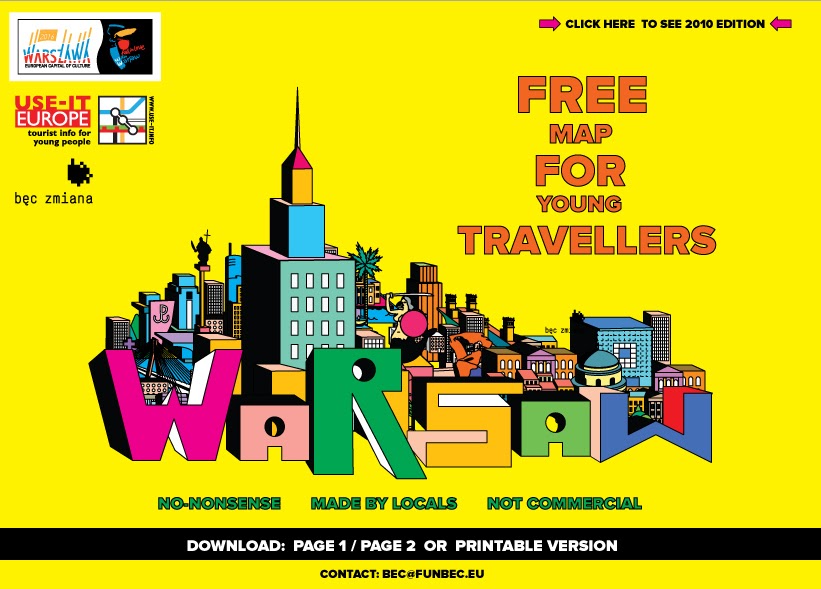
Use it! Free maps for young travellers!

'Use it - Europe' names itself as a tourist information for young people.Thanks to them, in the biggest cities of each country in Europe we can find free maps, which are not only useful, but also well designed and with very detailed descriptions (of pubs, cafes, places of interest, local customs etc.). What's more, our staff took part in preparing the first edition of the map of Warsaw. So you can rely on it! :)

To have one for yourself you can: ask for it in a hostel, search for it in some cafes, museums or touristic info points. You can also download it from the website! Here you can find a map of Warsaw and Łódź. To search for other European cities click here.


Apr 27, 2011

NeSpoon - a little bit different street-art.

Poland has its own unique street art and NeSpoon is an artist who certainly deserves attention. Why? Because of the pretty little things she makes. She is decorating Warsaw with so called “jewellery of the public space”. You can find them on walls, pavements, dustbins or even trees and baroque sculptures. NeSpoon prefers to call her work “outdoor art”, not “street art”. That’s because most of it is not strictly on the streets, but also in parks etc. Also the technique is pretty unusual. It’s ceramics. NeSpoon's typical and favourite pattern is Polish traditional lace imprinted in clay. 

The purpose of NeSpoon's work is to make public places look better, more interesting, prettier. She says that she would like to save the world and make it a better place. But she perceives it is impossible to do it all by herself. So she is doing her best by adding her bit of positive energy into Warsaws streets and other spaces. She would like to bring a smile to people’s faces every time they discover one of her small applications.

NeSpoon is also the first artists I know who makes so called “children street art”. Ceramics made by her in shapes of colourful ladybirds and lovely dragons have a specific purpose. They are made to teach kids how to find something charming in walls and in the nooks, and that sometimes small things are also very important things.

The art of NeSpoon proves that you don’t need anything big and well exposed to make the city look happy and interesting. Searching for tiny details can bring you great fun and satisfaction. So, while having a walk around Warsaw (but not only!), keep your eyes wide open and maybe you will find pieces of urban jewellery! 


NeSpoon in Łódź - in cafe Owoce i Warzywa (Fruits and Vegetables)

PS. Visit NeSpoon's blog. And here is a little tip where to find some of NeSpoon's works in Warsaw.

Read more about Polish street art:
Adidas defeated 
Chopin from the block