Showing posts with label sightseeing. Show all posts

Dec 12, 2012

Happy Birthday Palm!

The Palm from De Gaulle's roundabout is 10 years old! Many people wonder why there is a canary island date palm in one of the Warsaw's most popular spots. The palm is part of a project 'Greetings from Jerusalem Avenue' by Joanna Rajkowska. The author of the project had planned to put a lane of palms along the street called Aleje Jerozolimskie (Jerusalem Avenue) but at the end they decided to put just one palm at the junction of Jerusalem Avenue and Nowy Świat street, on some kind of a traffic island.

The tree is 15 m tall, it's waterproof and made mainly of plastic. There was a long discussion going on during preparations to make the idea of the palm come true. There were many doubts about who's gonna take care of the palm, who will pay for it, how long should it stand on the roundabout, about copyright lawsand of course about its political and cultural context.

Origins of the project date back to the artist’s journey to Israel (in Tel-Awiw there is a street called Jerusalem Avenue too) and her attempt to realise and the others aware of the significance of Jerusalem Avenue to Warsaw, the street’s history and the vacuum caused by the absence of Jewish community. It was supposed to be also a social experiment, testing whether the Polish society is ready to absorb such a culturally alien item. The spot at which the palm has been placed before the year 2002 had been used for a Christmas tree :)

The palm still sparks extreme feelings. It has divided Warsovians into those treating it as a symbol of a city and a society welcoming the others, developing, focused on the change, and those that support order, tradition and a city closed for strangers. The palm brings about many divisions and fuels conflicts deeply hidden in Polish society. It contains a lot of humour and irony as well, which saves it from definitions that could subdue it to any ideology. However, despite many different statements about the palm, it has become a symbol of Warsaw and one of the most characteristic points of the city.

More about the Palm you'll find on the official website: http://www.palma.art.pl/
View in Poniatowski's Bridge direction

Mar 14, 2012

Off to Cracow!

Yeah! I've got a day off and I've decided to go to Cracow for a little bit of sightseeing, a little bit of good food and coffee. I'm taking a 9.30 am train from Warszawa Zachodnia station (but you can go also from Warszawa Centralna station) and I'll be in Cracow at 12 o'clock. That'll give me all day of walking, eating and relaxing :) In the evening I'm going back to Warsaw.
How to make a trip like that (and better ones)? Check the train timetable on the Polish Railway's website.

Mar 8, 2012

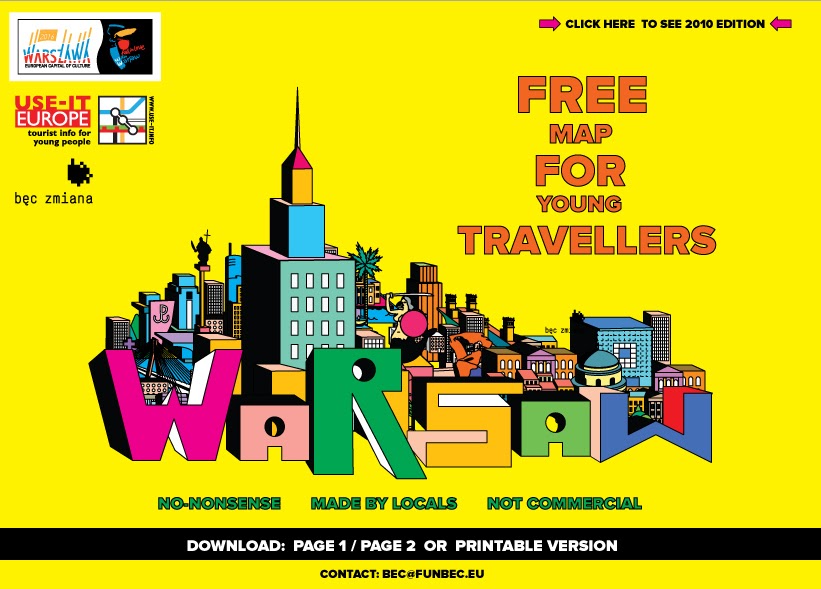
Use it! Free maps for young travellers!

'Use it - Europe' names itself as a tourist information for young people.Thanks to them, in the biggest cities of each country in Europe we can find free maps, which are not only useful, but also well designed and with very detailed descriptions (of pubs, cafes, places of interest, local customs etc.). What's more, our staff took part in preparing the first edition of the map of Warsaw. So you can rely on it! :)

To have one for yourself you can: ask for it in a hostel, search for it in some cafes, museums or touristic info points. You can also download it from the website! Here you can find a map of Warsaw and Łódź. To search for other European cities click here.


Feb 17, 2010

The Jewish Paths of Warsaw

Using wonderful GOOGLE MAPS we have prepared another map than might be useful for sighseeing in Warsaw. We are pround to present "The Jewish Paths of Warsaw".

Click to open in new window


Pokaż The Jewish Paths of Warsaw na większej mapie

The Warsaw Ghetto

It was the largest in Europe occupied by the Nazis. Its population was estimated to be 400,000 people, about 30% of the population of Warsaw at that time.

To imagine the Warsaw Ghetto see (the fragments) of "The Pianist", a film by Roman Polanski

http://www.youtube.com/watch?v=ivYHhW-v3x8

Jun 8, 2009

3D VR 1905


Three Dimensional Virtual Reality. It sounds very modern, but we have been having it in Warsaw since 1905! It is called FOTOPLASTICON and is still working in the same way as over hundred years ago.

Address: Al. Jerozolimskie 51 see on google maps Open daily except for Tuesdays 10-18, admission 1PLN (appr. 0,25 EUR), free on Sundays.

Now you can walk through the streets of many cities by using Google Maps street view option. Hundred years ago people had the same need of virtual traveling and fotoplasticons were very popular across the world.
Fotoplasticon gives possibility of viewing photographs, made with technology called stereoscopy. Each eye has it's own point of view (close left one, then right one - you'll see that the view is a bit different- in your brain these two pictures are mixed into 3D view).
So for viewing 3D photographs a "double" picture (see the photo above) is needed. It's made with special camera having two lenses. As the distance between lenses is similar to the distance between eyes, watching this double picture gives impression of three dimensions when you see the left picture with the left eye and the right with the right one – you need some kind of binoculars for it.
Exactly the same trick is made for contemporary 3D movies - there are two views and the glasses you wear in the cinema allow to separate "left" and "right" movie and direct it to the proper eye.


Interesting links:
More about fotoplasticon in Warsaw
Stereoscopy

May 27, 2009

Somewhere in Poland (3) - The Far East


The Far East is about 200km east of Warsaw. I know that in some countries it could be a distance to the nearest supermarket, but here it's a distance to different culture. Some guidebooks call our eastern border "exotic Poland". Only there you'll find a mixture of cultures containing Christian, Orthodox, and Muslim believers.
However, Poland is considered to be catholic country (33 millions of Christian catholics) and churches are significant signs in our landscape, finding a typical church in the Far East it's not so easy.
The Far East is orthodox (half million believers) and in the villages you'll find orthodox churches with characteristic towers with triple crosses. Some people do not even speak Polish there - the mixture of Belorussian and Polish with
characteristic "singing" accent is in use, as the settlers from Belarus had been here before the Poles arrived from the west in XVI century. So speaking polish does not mean 100% success in communication, however, those languages are similar, and after some tries you can get across when asking for a way or just chatting with someone in a village. What's more some inscriptions on shrines, crosses and graves are written in Cyrillic. Young people, that haven't had Russian at school are not
able to read it. Orthodox celebrate they events according to Julian calendar, so everything happens there two weeks later.
You can spend Christmas or Easter in Warsaw, and then two weeks and two hours drive later you'll have it again!
Not only orthodox, but also Muslims have found they place in the east. Two mosques built in XVII century are still in use by descendant of Tatars who were given this grounds four hundred years ago.
The East has his unique quiet atmosphere, even dogs in the villages seem to bark more silent. Wooden houses with characteristic shutters and porches and decorated corners are popular here.
If you accept only tourist attractions mentioned in Lonely Planet - Bialowieski National Park would be a good choice - meeting a bison in the wild it's still possible there. Finally, if you are interested only in clubs and bars sections of the above guide, you have to know that only in the region of Bialowieża grows a grass used for making world famous Żubrówka Vodka (Bison Vodka). Cheers!


Check out more interesting places in Poland:

May 22, 2009

The Bridge of Sighs


Imagine there was a bridge upon this street. Those who were beneath it - had the right to live. Those who crossed it - did not. They were Jews walking between large and small ghettos in Warsaw during the II World War.The Chłodna Street (Cold St) was essential for a traffic in the city so the German occupation authorities decided to exclude it from the Ghetto and therefore they built the bridge that joined both parts of it. The Jewish called it: "Bridge of Sighs". The sighs for a normal life that went on under the bridge.
See more: http://en.wikipedia.org/wiki/Warsaw_ghetto
Today the Cold Street is one of my favourite samples of Warsaw. It is all this city is about: tragic history, skyscrapers of glass, suspicious business and underground culture. It is peaceful and nostalgic. All cobbled with forgotten tram-tracks in it. Go there to see what a strange feeling it is when you cross a symbolic line of the Ghetto Wall in a pavement so easily while for the Thousands it was a dream that never came true.
In the corner of the Chłodna St and Żelazna St (exactly were the Bridge of Sighs used to be) there is the Chłodna 25 Cafe - a very important place in a cultural map of Warsaw with loads of good off -artists' concerts in the evening and aromatic latte in the morning (open daily from 8am till the last customer). You will find a mural of the Ghetto Bridge just opposite the cafe.
When you walk the Chłodna St towards the West you will have a chance to meet suspicious guys standing in front of dark "houses of games", lawyers and sellers of brushes (all these guys work in the same ruined pavilion).
If you go the eastern direction instead you will get to the bustling Jana Pawła St (the street of the Pope John Paul II) and to the old Market Halls of Mirów. There is a fantastic flower market in the front of it. It is open every day all year round.
Before you take a tram to the city centre have a good look. Would you believe all this area was completely flattened of bombs?


May 19, 2009

Ride a cruiser!


Wow! This is something that Warsaw was waiting for years. It's hard to believe, but we haven't had any 100% backpackers oriented activity so far... There have been some guided tours, of' course there's a lot of pubs, clubs, concerts, events and generally a lot of to do...but nothing so special as ELECTRICTOURS. Now you can simply connect sightseeing with fun. Warsaw seen from the comfortable saddle of a cruiser bike with unique design looks much better, you can see more and bring home pictures with you sitting on a bike, that makes impression on everyone.


See Electrictours - Warsaw Bike Tours for details or ask at the hostel

To see other posts on cycling click here.


May 6, 2009

Warsaw Street View

"Street view" option it's not (yet) avaliable for Warsaw on Google Maps but
I've find a local service that allows to view street panoramas of Warsaw.
Please click www.norc.pl for exploring streets of Warsaw in your browser.

Apr 27, 2009

Somewhere in Poland - My Favourite Bridge


My favorite bridge is in Tykocin. It's over the Narew River. Steel construction perfectly composes with the road and the white church in the background. In comparison to other truss bridges, this one is significantly lower and does not dominate the foreground. It looks perfectly in the early evening, lighten by warm sunlight.

Tykocin itself is a very good place to stop for a day or two. It's known as a place worth to visit, but there are no crowds. People stop here only for a walk, take some pictures and carry on they journey. In the evening the place completely regains his eastern atmosphere. This town has a perfect balance between doing ant not-doing.
You can go for a walk along cobble streets. You can take some good pictures of wooden architecture. You can visit old synagogue, old jewish cemetery. Or you can sit on the main square and observe as the time passes slowly. The area around the city is worth mentioning too. It's surrounded by endless meadows with labyrinth of roads perfect for cycling, walking and horse riding. Birds and birdwatchers often meet here. It's enough to rise one's head to see a stork nest. Two national parks (Biebrza River NP and Narew River NP) are within one hour drive distance.

How to get: By car (170 km / 3 hours drive from Warsaw). By train / bus: Train to Bialystok, then bus to Tykocin.
See
Tykocin on the Google Maps

Other places somewhere in Poland:
Somewhere in Poland (2) - 843 km of beaches 
Somewhere in Poland (3) -  The Far East
Somewhere in Poland (4) - Water way to the border